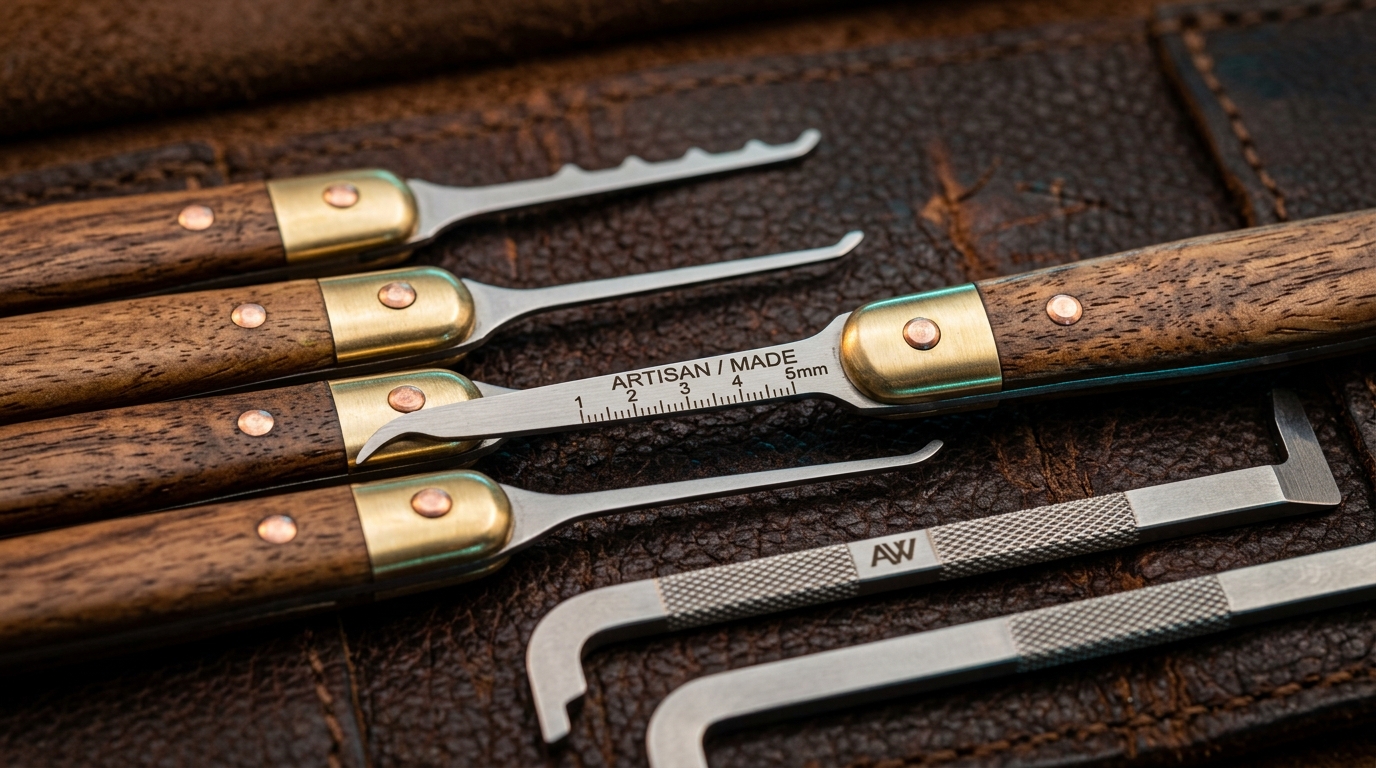
We live in an epoch of seamless injection-molded plastics and disposable, throwaway obsolescence. Consumer goods are deliberately engineered to be impenetrable—sealed with ultrasonic weld joints, devoid of fasteners, stamped from brittle alloys designed to fail the day after the warranty expires.
When you spend an evening in the workshop working thick vegetable-tanned bridle leather and high-carbon steel, you inhabit a different universe entirely.
The Language of Heavy Harness Leather
Vegetable-tanned leather is not a passive material. It carries the memory of the beast and the tannin bath of oak and chestnut bark.
When you slice into a 5-ounce bend with an antique Japanese skiving knife, the blade meets a firm, waxy resistance. The fragrance of pine bark, beeswax, and natural fats fills the air.
To saddle-stitch leather by hand is a ritual of monastic discipline:
- You groove the stitch line with a wooden-handled compass.
- You pierce the diamond-shaped holes one by one using a pricking iron tapped with an antler mallet.
- You thread two harness needles onto a single strand of heavy braided poly cord dressed with pure Manitoba beeswax.
- You cast the needles through the hole from opposite sides, pulling the knot tight with an identical tension on every stroke.
A sewing machine creates a “lockstitch” that will unravel entirely if a single loop wears through. A hand saddle-stitch, by contrast, interlocks two independent thread paths; even if one strand is severed by decades of hard friction, the remaining thread continues to hold fast.
It is slow. A single small notebook cover or tool roll takes three hours of rhythmic, quiet hand labor. But when it is done, it is built to survive half a century of pocket wear and prairie dust.
“A machine produces identical objects with zero soul. A hand tool leaves behind microscopic variations—the human heartbeat immortalized in cold material.”
The Cold Touch of High-Yield Steel
Beside the stitching pony sits the metal bench.
Here, strip stock of 301 stainless steel and free-machining C360 brass are shaped not by computerized laser cutters, but by diamond files, wet oilstones, and fine Arkansas slip stones.
When you file metal by hand, your ears become as sensitive as your sight. The sound of a bastard cut file changes frequency as the high spot on the steel blank is leveled. You feel the microscopic burr with the pad of your thumb. You polish through grades of silicon carbide paper—400, 800, 1200, 2000—until the scratch marks vanish into a deep, dark mirror finish that reflects candlelight like black ice.
Why We Build
Why spend hours shaping a tool or stitching a journal cover when an overseas factory can churn out a plastic substitute for pennies?
Because the object you purchase leaves no imprint upon your soul. You are merely its temporary consumer.
When you make something with your own hands—when you sweat over the anvil, prick your finger with an awl, or spend three nights filing a brass ferrule to a perfect taper—you invest a fragment of your finite mortal hours into the physical fabric of the object.
Long after we are gone, someone will open that leather roll or turn that brass dial and feel the weight, the care, and the silent presence of the craftsman who shaped it in the dark.